The chest wall, which nobody contours until it hurts
A peripheral lesion sits against ribs. The dose that reaches them is the most common late toxicity of lung SABR, and it is entirely a planning decision.
Built in·updated 2026-08-20
For a peripheral tumour the chest wall is often closer to the target than any organ on the constraint list, and it is the one people leave uncontoured because no protocol table forced them to.
The number that predicts trouble is V30Gy. Chest wall volume receiving ≥30 Gy has the strongest dose–response of the levels tested (R² = 0.96 in the original series). Around 30–35 cm³ above 30 Gy corresponds to roughly a 30% risk of grade 3 pain or rib fracture. Keeping V30Gy under 30 cm³ is the usual planning aim, with individual rib D2cc under about 27 Gy in 3 fractions.
What actually happens to patients. Reported chest wall toxicity ranges widely, 8–46% across series; a pooled Bayesian estimate puts rib fracture at 6.3% (95% CI 3.7–9.7). Most fractures are asymptomatic — about 34% of patients with a fracture have pain. It is slow: pain at a median 6–9 months, fracture at a median 13–22 months. Nobody sees this at the follow-up that happens while they still remember the plan.
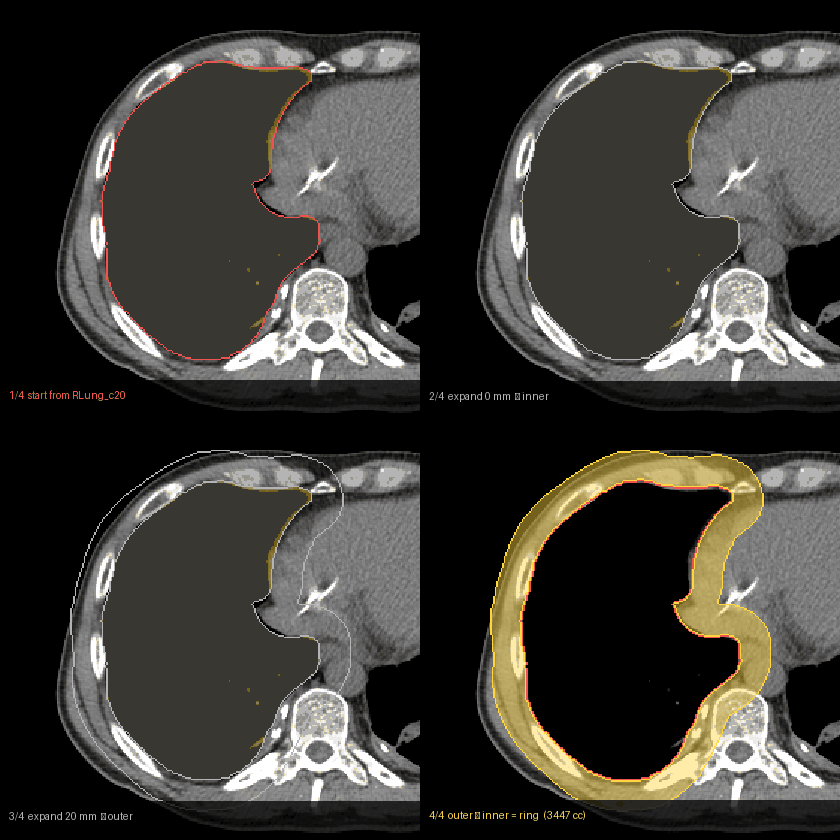
In planning. Contour the chest wall as a 2–3 cm band of the ribs and soft tissue adjacent to the PTV rather than the whole thorax, or the volume metric means nothing. Then the trade is the ordinary one: entry through the chest wall is short and shallow, so beams that enter over the lesion give up little in lung dose to concentrate dose in ribs. Spreading entry angles costs a little V20 and buys chest wall.
Worth saying in a write-up, because a plan with excellent lung numbers and a chest wall V30 of 60 cm³ has made a choice, and the score card will not show it unless the case scores it.
How the structure is built
Where the numbers come from
- Chest wall volume receiving >30 Gy predicts risk of severe pain and/or rib fracture after lung stereotactic body radiotherapy
International Journal of Radiation Oncology Biology Physics · 2009
V30Gy is the strongest predictor; ~35 cm³ above 30 Gy corresponds to a 30% risk of grade 3 pain or rib fracture
- Predictors and characteristics of rib fracture following SBRT for lung tumors
BMC Cancer · 2023
Rib fracture 6.3% pooled (95% CI 3.7–9.7); 34% of fractures symptomatic; fracture at a median 13–22 months
- Low incidence of chest wall pain with a risk-adapted lung SBRT approach using three or five fractions based on chest wall dosimetry
PLOS One · 2014
Choosing 3 vs 5 fractions on chest wall dosimetry keeps chest wall toxicity low