R50 and D2cm — the numbers that judge SABR fall-off
Conformity says how well the prescription hugs the target. These say how fast the dose leaves, which is the part that decides whether a SABR plan is good.
Built in·updated 2026-08-20
Two numbers, both from the RTOG lung SABR protocols:
- R50 — the volume of the 50% prescription isodose divided by the PTV volume. How wide the half-dose cloud is relative to the target.
- D2cm — the maximum dose anywhere 2 cm or more from the PTV, in any direction, as a percentage of prescription. How much dose escaped to somewhere it has no business being.
Both limits depend on PTV volume, and the direction surprises people. A small PTV is held to a looser R50 than a large one. That is geometry, not leniency: R50 is driven by the surface-to-volume ratio, and a small sphere has proportionally far more surface. The analytic form makes it explicit —
— where is the radial thickness of the 50% shell. Halve the radius and SA/V doubles, so the same physical fall-off gives a much larger ratio. Comparing raw R50 between plans on different-sized targets tells you almost nothing.
Which protocol. The tolerance tables live in RTOG 0813 for centrally located tumours and RTOG 0915 for peripheral ones. Both give three action levels — none, minor deviation, major deviation — against PTV volume. As an anchor: a PTV of about 46 cc carries a no-deviation bound near R50 ≤ 4.1 and D2cm ≤ 61%. Read the row for your own volume out of the protocol rather than interpolating from that one.
How to move them. R50 responds to the intermediate-dose shells and to how much low-dose spray the arcs leave; D2cm is usually one direction leaking, so look at where the 2 cm ring is hottest before touching global weights. ring falloff is the mechanism; this skill is the target.
How the structure is built
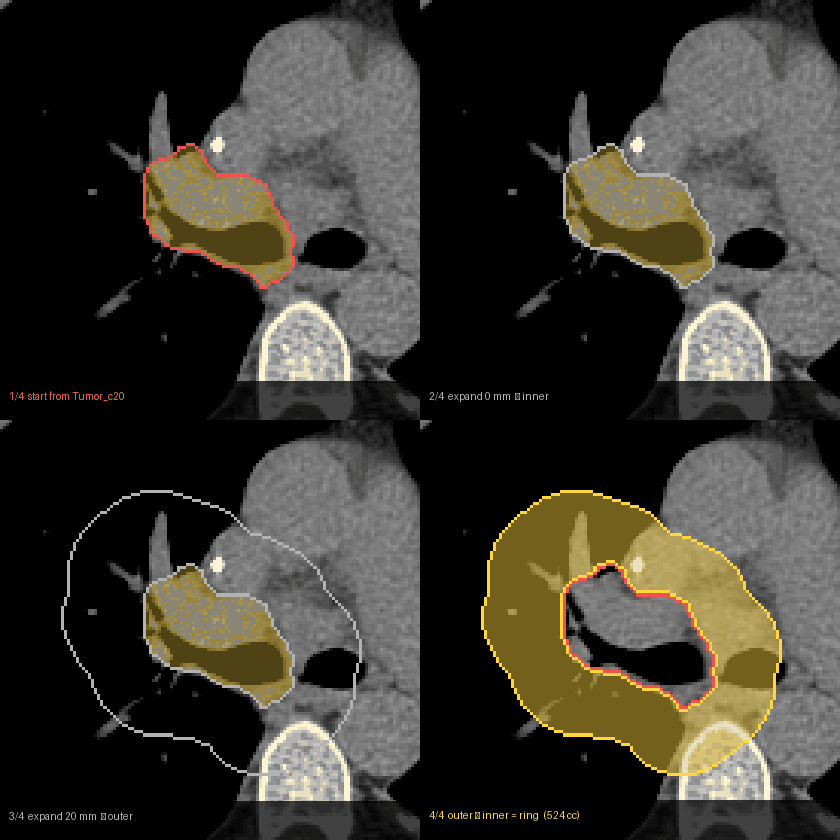
Where the numbers come from
- Cleaning the dose falloff in lung SBRT plan
Journal of Applied Clinical Medical Physics · 2021
RTOG 0813 covers central and 0915 peripheral tumours; a ~46 cc PTV interpolates to an R50 bound of 4.1 and D2cm of 61.1%
- An analytical expression for R50% dependent on PTV surface area and volume: a lung SBRT comparison
Journal of Applied Clinical Medical Physics · 2020
R50 = 1 + (SA/V)·Δr·[1 + Δr/r + ⅓(Δr/r)²] — small targets carry a higher R50 for the same physical gradient